



Appliqué is the most wonderful thing that can happen to a child. After all, here you are allowed to tear, crumple, glue, and cut with scissors! In the process of this creativity, the child learns new possibilities of the world around them. The more toddlers "work" with their fingers - kneading, stroking, sorting, folding, cutting - the more their sensory skills develop.
While doing appliqué, a child engages all their sensory abilities: distinguishing colors and shades of paper for creativity, feeling the variety of materials (leaves, cones, twigs, chestnuts), hearing the rustle of paper, the crunch when cutting it, smelling paint, glue, or natural materials...
For a child, appliqué activities are not only interesting and educational but also a part of their development. It is appliqué that develops a sense of beauty in children, serving as the first step for a future designer – it develops artistic skills. The child learns to harmoniously select colors, work with shapes, and reproduce and invent various compositions.
Children can convey the world around them through appliqué. They can easily construct a house, a tree, or a sun from simple geometric shapes.
With a proper approach, a child can easily:
- prepare the ground for counting and reading,
- develop logic,
- train memory and attention,
- develop coordination and imagination,
- prepare their hand for writing,
- develop perseverance,
- learn to make decisions independently.
Materials and tools
Appliqué can be diverse: flat or volumetric, monochrome or colorful, made from one or many materials.
In recent years, handmade crafts have been actively developing, so the recommended materials for appliqué have significantly expanded their assortment.
Suitable for children's activities:
- paper and cardboard (school art kits, crepe paper, wrapping gift paper, napkins, newspapers, magazines, postcards...),
- cardboard (school, packaging, corrugated cardboard, designer...),
- textiles - fabric (calico, cotton, knitwear), threads, ribbons, braids, felt, cotton wool,
- natural materials - dried leaves, flowers, seeds, husks, nut shells, eggshells,
- plastic masses - plasticine, dough, clay,
- groats - rice, buckwheat, semolina, peas,
- decorative elements - craft kits, buttons, beads, pebbles, sequins, volumetric stickers,
- and anything that can be cut and glued and does not harm health.
If you've just decided to try appliqué with your child and don't know where to start, begin with colored paper and cardboard. These are the simplest and easiest materials to use. Choose the brightest colors for your appliqués and boldly experiment with your little one!
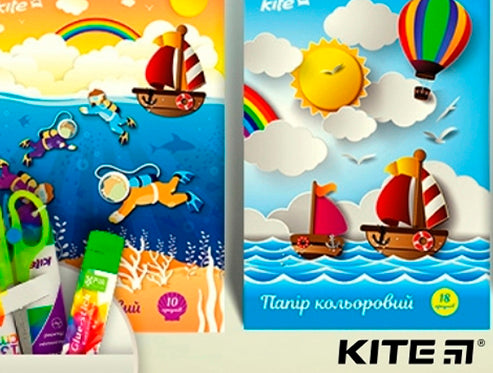
Kite will help you choose high-quality, bright, and durable paper – let your creativity become a small family tradition.
Information taken from: prostobaby.com.ua/rebenok_ot_1_do_3_let/stati/applikatsiya_s_detmi_universalnoe_i_uvlekatelnoe_zanyatie

